
Bioethanol – Mengzhou Huaxing Alcohol, 200,000 tons/year
2026-08-18
| Section | Description |
| Project Description | Large-scale production of high-purity fuel ethanol with a capacity of 200,000 tons per year from grain raw materials (fermentation and rectification) of the Huaxing Alcohol company. Absolute ethanol is produced using a continuous pressure swing adsorption (PSA) process at 135°C. |
| Installation performance | Raw alcohol vapor consumption at the inlet: 32,000 kg/h; residual water content in anhydrous ethanol: ≤ 200 ppm. |
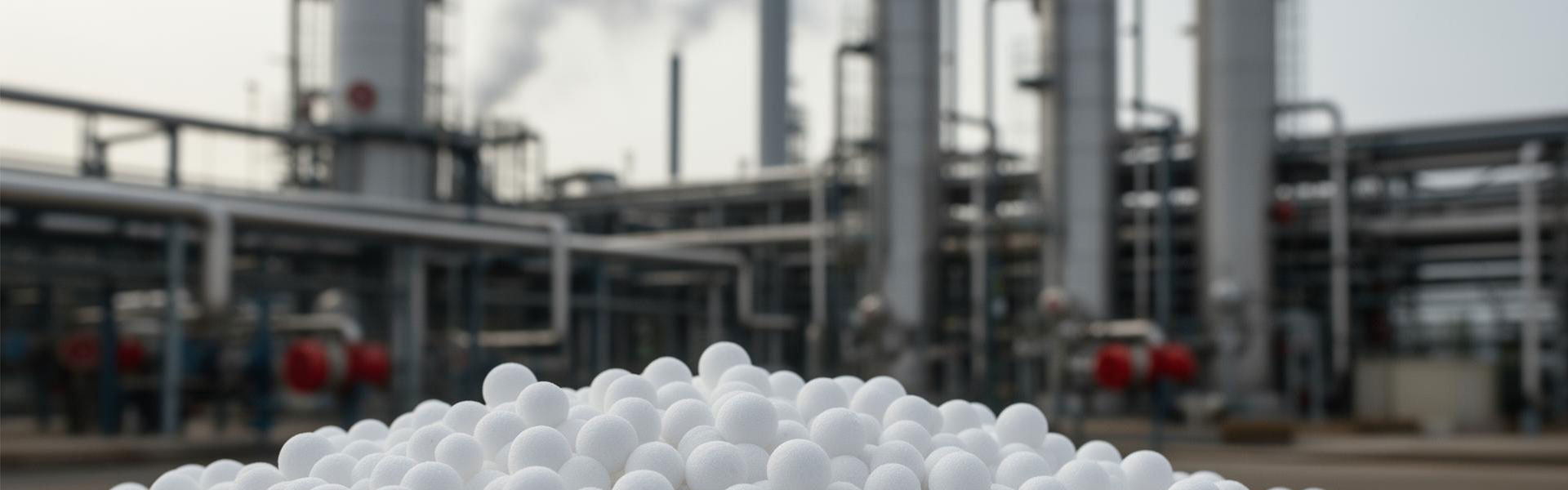
| Products used | Specialized and pollution-resistant molecular sieve type 3A for bioethanol fuels, granule diameter 3.0-5.0 mm, improved mass transfer class. |
| Technical solution | Resistance to complex volatile impurities of biomass (fusel oils, acetaldehyde, trace sulfur and amino-containing polar compounds), which cause accumulation and chemical decontamination in the pores. Achieved through a special inert treatment of the zeolite surface, which prevents physico-chemical poisoning and thermal aging. |
| Key Benefits | Absolute protection against blackening and carbonization of pores: exceptionally stable cationic position of exchangeable potassium, completely prohibiting the penetration of fusel oils into the lattice and coking reactions. Excellent hydrothermal stability: no cracking, peeling or destruction of granules during sudden changes in temperature and humidity, which guarantees long-term trouble-free operation. |

Adsorbents for deep ethanol drying – 70% market share in China
In the field of deep drying and production of absolute ethanol (fuel, fine chemical and pharmaceutical grade), temperature vibrational adsorption (TSA) technology on 3A molecular sieves occupies a dominant position with a market share of approx.70%.
•Physico-chemical principle of deep drying:Ethanol and water form an azeotropic mixture (water content about 4.4%). Conventional rectification does not allow one to overcome the azeotropic point and obtain a product with a strength higher than ~95.0%.
•Precision molecular sieve effect 3A:Type A zeolite in potassium form is used. Its micropore size is strictly controlled in the range of 3.0 ± 0.2 Å. A water molecule with a kinetic diameter of 2.6 Å easily penetrates into the pores and is firmly held by a strong polar field, while an ethanol molecule (diameter 4.4 Å) is completely excluded from the internal volume of the crystal.
• Technological and economic advantage: The complete exclusion of large ethanol molecules from micropores completely suppresses side reactions, such as high-temperature condensation with the formation of diethyl ether, fusel compounds and subsequent coke formation. This ensures stable vapor phase operation of TSA at 110-140°C without the use of any external azeotropes.