
56,000 Nm³/h (56 thousand) – Russia / Hanyang
2026-08-10
| Section | Description |
| Project Description | Cryogenic ASU with a capacity of 56,000 Nm³/h (5.6W) as part of a large metallurgical plant in the central part of Russia. The complex equipment was supplied by the Chinese company Hanyang. The project is characterized by extreme annual fluctuations in air temperature and humidity, the drying and cleaning unit operates on the TSA cycle. |
| Installation performance | Total flow rate of processed air: 290,000 Nm³/h; Oxygen gas production: 56,000 Nm³/h, purity ≥ 99.9%. |
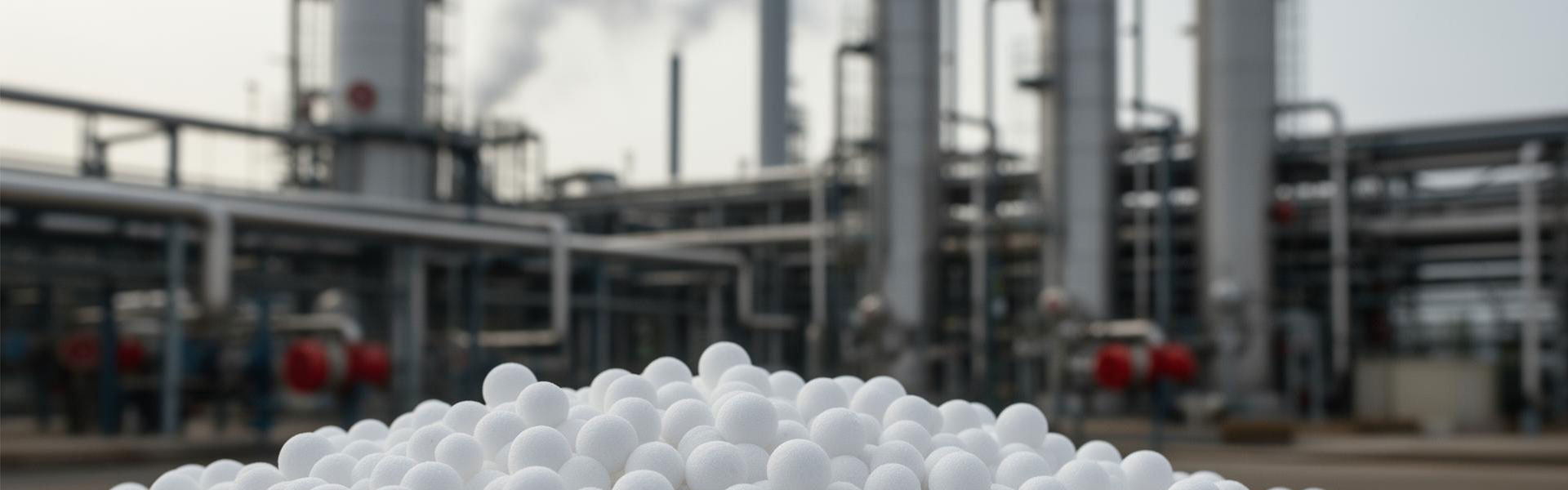
| Products used | High efficiency molecular sieve 13X-APG-III for ASU, granule diameter 1.6-2.5 mm. |
| Technical solution | An adsorbent with increased resistance to thermal shock under conditions of extremely low temperatures (down to –40 °C) and sudden changes in humidity at the inlet. The design of the layer ensures deep drying and a stable CO₂ content at the outlet ≤ 0.5 ppmv, which guarantees the absence of icing and clogging of the cryogenic block channels. |
| Technical advantages | Increased static capacity for CO₂ and H₂O; high mechanical strength and thermal stability; preventing clogging of microchannels of a plate-fin heat exchanger; reduction of regeneration gas consumption. |
| Operation results | Stable and reliable operation of the cleaning unit at abnormally low ambient temperatures; The risk of explosion in the oxygen column is eliminated due to the reliable retention of acetylene and heavy hydrocarbons. |

Adsorbents and catalysts for air separation units (ASU)
The pre-treatment unit (PCU) of the air separation unit is a critical component that determines the safe operation of the low-temperature distillation unit. Atmospheric air contains microimpurities of water, carbon dioxide and hydrocarbons (acetylene, propane, etc.). When entering a cryogenic cold block with a temperature below –170 °C, moisture turns into ice, CO₂ freezes out in the form of solid carbon dioxide, which leads to clogging of the microchannels of plate-fin heat exchangers. The accumulation of acetylene and other light hydrocarbons in liquid oxygen creates a risk of explosion in the distillation column. In this regard, BPO predominantly uses temperature-oscillatory adsorption (TSA) technology using molecular sieves with high adsorption capacity and resistance to mechanical destruction.
New generation molecular sieves for ASU, due to their pronounced polar structure, demonstrate an increase in static adsorption capacity for traces of CO₂ and moisture by more than 50% compared to traditional 13X-APG. This ensures high adsorption efficiency and long service life in extreme industrial atmospheric conditions, allows you to significantly reduce the size of adsorbers and reduce the energy consumption of compressors.