
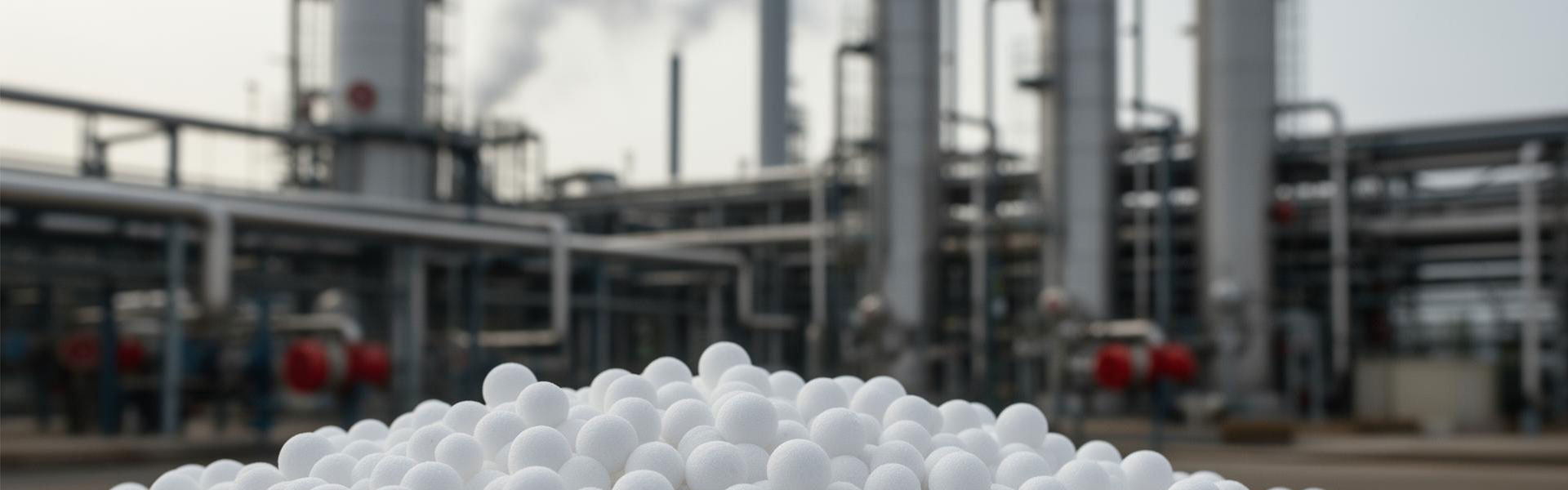
Project 20,000 Nm³/h (2W) – Nanjing steel
2026-08-18
| Section | Description |
| Project Description | An ultra-large, high-load monoblock VPSA plant for centralized oxygen production with a capacity of 20,000 Nm³/h, built for the Nanjing Steel Plant. |
| Installation performance | Oxygen capacity per unit: 20,000 Nm³/h; oxygen purity: ≥ 80%. |
| Products used | High performance low silicon Li-X molecular sieve with high capacity, granule size 0.8-1.5mm. |
| Technical solution | Implementation of a three-adsorber VPSA scheme with ideal synchronism and symmetry of the distribution of gas flows between devices. An adsorbent with extremely high homogeneity and monodispersity of granules ensures an absolutely uniform pressure drop across all adsorbers. The layer design is resistant to tangential shear stresses with ultra-fast switching of the solenoid valves (less than 0.3 s). |
| Key Benefits | Minimize specific energy consumption: every 0.25 kWh/m³ reduction in energy consumption provides multi-million dollar annual savings for installations of this size. The exceptional crushing strength of the granules and the preservation of layer packing density prevent the need for frequent and labor-intensive reloading or replacement of tens of tons of adsorbent. |

Zeolites for VPSA oxygen production plants – examples of implementation
Vacuum pressure swing adsorption (VPSA) is an advanced technology for extracting oxygen from air, based on the significant difference in the equilibrium and kinetic adsorption capacity of molecular sieves for nitrogen and oxygen.
• Physical mechanism of adsorption:The process is based on the use of lithium-exchange low-silicon synthetic zeolite type X (Li-LSX). Lithium cations (Li⁺), having an ultra-high charge density, create a powerful electrostatic quadrupole interaction with nitrogen molecules. As a result, nitrogen is firmly physically adsorbed in the micropores of zeolite at atmospheric or slight excess pressure (0.05–0.15 MPa), while oxygen passes through the layer almost unhindered, providing oxygen-enriched gas with a purity of about 93%.
• Mechanism of desorption and regeneration:When the layer reaches saturation, it is regenerated by quickly creating a vacuum (from –0.04 to –0.07 MPa) with backflushing for nitrogen desorption. Thus, cyclic oxygen production is realized. Because the process is a short-cycle process with high pressure switching frequency, critical factors for design and operation are the high volumetric kinetic adsorption capacity, the exceptional polar selectivity of the adsorbent, and its high mechanical strength to prevent abrasion and dust formation.